J. Kelly Robison
The purpose of citations is to allow the reader to ascertain where the writer obtained the information cited. This allows future writers to use the work as a source in their own writing. History is not an individual endeavor. Historians build on the writing of others, furthering what previous writers have done and advancing knowledge in general. Citations are necessary since they allow the reader to determine if a source is useful, if it has been used in the appropriate manner, and also to check to see if the writer made any mistakes when using that source. Using footnotes is also honest. Using information, such as an idea, that is not one's own, yet failing to adequately explain where this information originated, is a form of stealing. Formally it is called intellectual dishonesty or plagiarism. Cite your sources!
If you do not cite your sources, the chances of passing that particular assignment are zero. Oftentimes, professors will fail students for the entire course if the student plagiarized. They are well within their rights to do so. Students may also be expelled from the school for plagiarism.
The writer must cite all information that is not out his/her own head. This includes all facts that are not general knowledge and ideas that are someone else's. For example, that the United States of American declared its independence from Great Britain on July 4, 1776 is general knowledge. Most all other information is not general knowledge and needs to be documented.
Cite everything! Many people believe that only quotations need to be cited. This is false. Yes, quotations do need to be cited, but so does almost everything else. When in doubt, CITE. It is better to use more citations than needed than too few.
Within the text of the paper, the only reference to a citation is a small, superscript number following the information that is being cited. Most word processing programs with a reference function automatically insert the correct number. The citation numbers must be consecutive all the way through the paper. If the paper has twenty footnotes, the the first citation number is 1 and the last citation number is 20. The numbering does not begin with 1 at the beginning of each page.
The number should be located at the end of the information that is being cited.
The form of the citation is the same regardless whether footnotes or endnotes are used. The only difference between footnotes and endnotes is location. Footnotes come at the bottom of the page and refer to all citations on that page. Endnotes come all at the end. Since the purpose of citing is to let readers know where the information came from, it is important to document this information as precisely as possible. The citation must include the author's name, the title of the work, the place of publication, the publisher, the year of publication, and the page number(s) on which the information could be found. If a journal or magazine article is the source, the note would also include the journal title, the month and year of publication, and the volume and issue numbers.
A sample book citation would look like this:
¹ Herbert Eugene Bolton, Spanish Exploration in the Southwest, (New York: Charles Scribner's Sons, 1916), p. 218.
A sample journal article citation would look like this:
¹ Eleanor Adams, "Fray Silvestre and the Obstinate Hopi," New Mexico Historical Review 38 (Apr. 1963):97.
A sample newspaper article citation would look like this:
¹ Andre Camilla, "Deciding Who Gets Dibs on Health-Care Dollars," Wall Street Journal, 27 March 1984, 30(W) and 34(E).
Note that the author's name is printed with the first name first, then the last name. Book, journal, and newspaper titles are either underlined or italicized. Journal or newspaper article titles are put in parentheses. Between each item of information should be a comma and the note should end with a period.
This is a very brief guide to citing sources. Kate Turabian's A Manual For Writers is a standard reference work for citations. The Chicago Manual of Style is a more complete guide, though both reference the same types of citations.
The following links help to explain citations in more detail, including the citing of web pages
Chicago Manual of Style Citation Quick Guide
http://www.lib.berkeley.edu/TeachingLib/Guides/Internet/Evaluate.html
http://www.liu.edu/cwis/cwp/library/workshop/citation.htm
http://webster.commnet.edu/mla/index.shtml
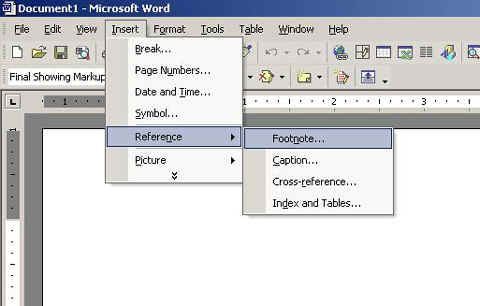
figure 1. opening the "reference" function
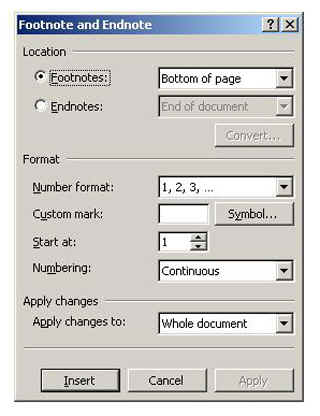
figure 2. setting the parameters for notes
Make sure that the Number Format is set to
numbers(1,2,3...) and that numbering starts
at "1". Use either Footnotes or Endnote, but
not both!
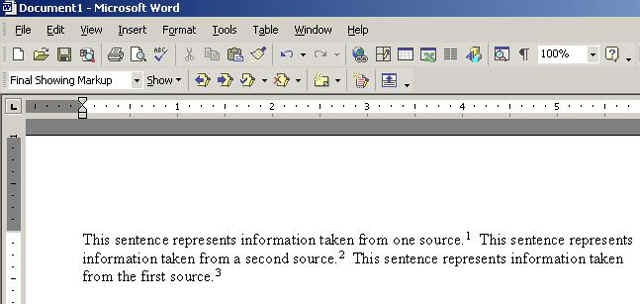
figure 3. example of notation within the text

figure 4. example of citations at the
bottom of the page (footnotes). Note
the use of a short citation for the
third citation. A short citation may
be used if there has been a previous
instance of a full citation.